Categories
Body
Correct use of RCF and RPM: Parameter conversion guide for centrifugation method transfer
Applicable scenarios and problem boundaries
When transferring methods, it is common to encounter old equipment, paper methods, or kit instructions that only give RPM, resulting in inconsistent results between different rotors. In a real laboratory or industrial analysis scenario, a centrifuge is not an isolated device but a connection point between sample preparation, detection methods, quality control and data traceability. Users often only focus on the maximum speed when selecting models, but ignore capacity, rotor adaptation, temperature control capabilities, noise, acceleration and deceleration curves, continuous operation stability and delivery services. When designing the product matrix, Veyon put these factors into the same decision-making table: low-speed and large-capacity models are responsible for batch samples and routine sedimentation, high-speed and ultra-high-speed models are responsible for efficient separation of micro-samples, refrigerated models are responsible for temperature-sensitive sample protection, and floor-standing equipment is for high-throughput and preparative tasks.
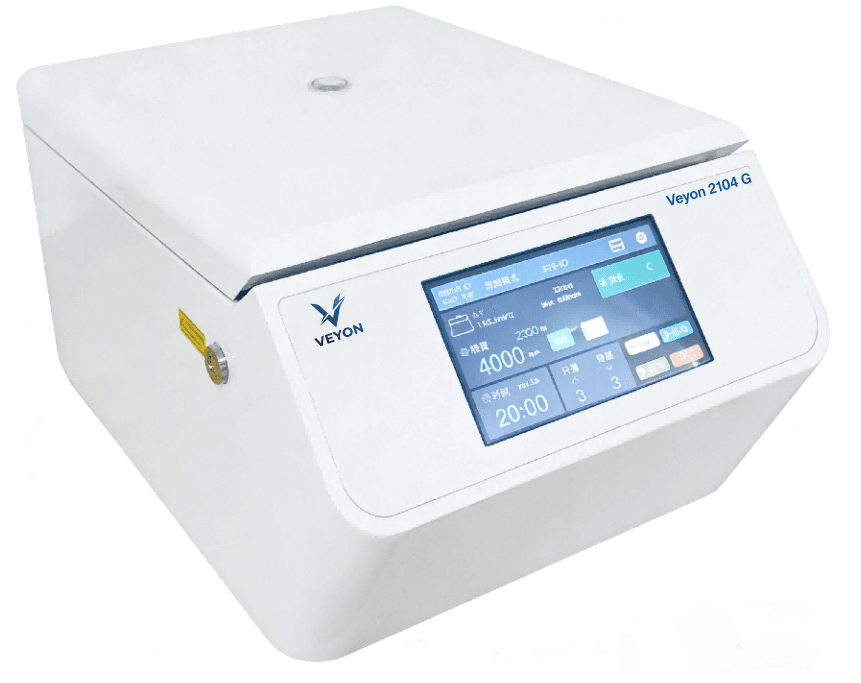
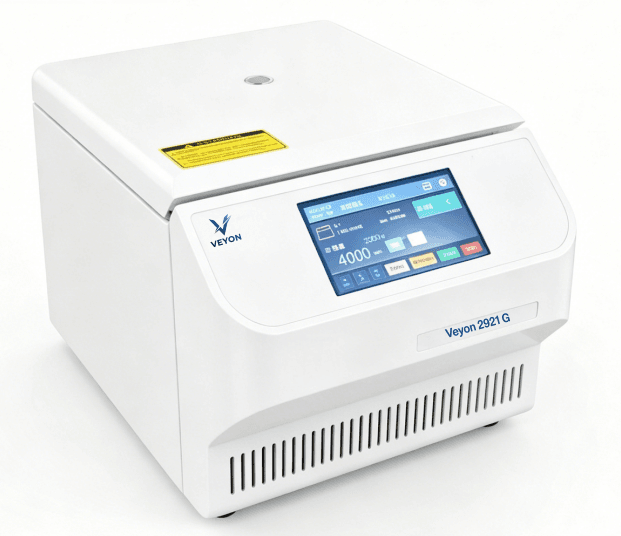
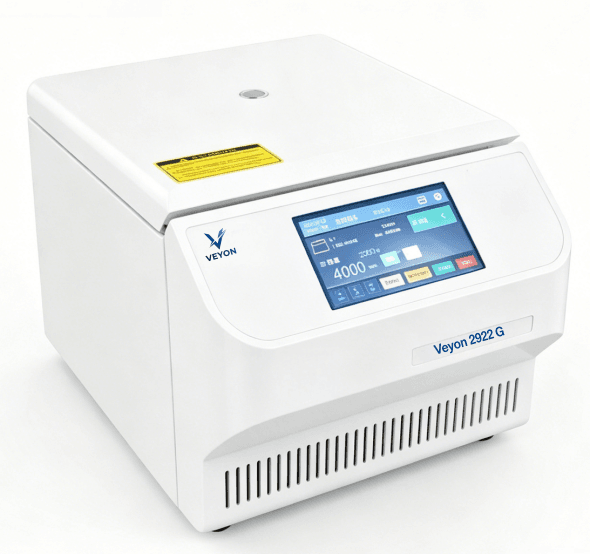
This article focuses on Veyon 2104 G, Veyon 2921 G, and Veyon 2922 G. It does not simply stack parameters into a list, but explains how to make executable configuration judgments from four levels: application goals, sample risks, equipment capabilities, and maintenance management. For procurement, laboratory leaders and process validation teams, the more important question is not "which machine has the highest parameters", but "which set of parameters can stably support my samples, consumables and delivery cycle".
Related Veyon product information
Veyon 2104 G (Veyon 2104 G desktop low-speed centrifuge): Veyon 2104 G intelligent desktop low-speed centrifuge is suitable for experimental scientific research units such as biochemistry, medicine, pharmacy, clinical trials, food and environmental protection. It is a conventional equipment for the separation and preparation of suspended liquids. Key parameters include the maximum speed of 4000 r/min, the maximum relative centrifugal force of 2600 × g, acceleration/deceleration rate of 1~4 gears, and overall dimensions of 490×340×270 mm.
Veyon 2921 G (Veyon 2921 G desktop high-speed centrifuge): Veyon 2921 G is an intelligent desktop ultra-high-speed centrifuge with a maximum speed of 21000 r/min and a maximum relative centrifugal force of 30319 × g. This equipment is specially designed for high-precision scientific research and biological sample separation, and is equipped with an industry-leading 7-inch high-definition full touch screen intelligent system. Key parameters include the maximum speed of 21000 r/min, the maximum relative centrifugal force of 30319 × g, acceleration/deceleration rate of 0~9 gears, and overall dimensions of 520×360×323 mm.
Veyon 2922 G (Veyon 2922 G tabletop high-speed centrifuge): The Veyon 2922 G speed is further increased to 22000 r/min, which can generate a relative centrifugal force of up to 38906 × g. The ultra-high-precision drive head motor structure achieves excellent smoothness and is suitable for molecular biology laboratories that require higher separation efficiency. Key parameters include the maximum speed of 22000 r/min, the maximum relative centrifugal force of 38906 × g, acceleration/deceleration rate of 0~9 gears, and overall dimensions of 520×360×323 mm.
From the product portfolio, Veyon 2104 G, Veyon 2921 G, and Veyon 2922 G cover parameter conversion and method reproduction from low-speed routine to high-speed scientific research. If the sample volume is large and there are many batches, priority should be given to checking the rotor capacity, adaptable tube type and unbalance protection; if the sample is temperature sensitive, priority should be given to the temperature control range, pre-cooling efficiency and cavity materials; if the task is mainly nucleic acid, protein or nanoparticle separation, the RCF, rotor radius, maximum speed and stable acceleration process should be evaluated together. The value of the Veyon product line is to form a continuous configuration from micro-volume high-speed to floor-standing high-capacity, rather than splitting different models into single-point choices.
Company capabilities and delivery logic
Guangzhou Veyon Biotechnology Co., Ltd. is a professional instrument company focusing on the research and development, customization and sales of high-end centrifuges. Its brand Veyon provides overall precision centrifugal separation solutions for life science research institutions, biopharmaceutical companies and industrial separation users.
The company deeply integrates top domestic OEM manufacturing resources and independently defines product specifications and rotor solutions. The product line covers desktop refrigerated centrifuges, high-speed floor-standing centrifuges and specialized large-capacity models for flow cytometry and high-throughput drug screening.
We take century-old international brands such as Beckman Coulter, Eppendorf, and Hettich as industry coordinates, and based on their engineering systems, we redefine product standards from a perspective that is closer to China's scientific research and industrial scenarios - shorter delivery cycles, faster local technology response, and human-machine design that is more in line with Chinese laboratory usage habits.
Precision is not a slogan, it is a physical commitment at every turn.
The history of centrifuges is the history of mankind’s game with gravity.
In 1924, Swedish chemist Theodor Svedberg built the world's first ultracentrifuge at Uppsala University, with a speed of 45,000 rpm, and accurately determined the molecular weight of proteins for the first time. Two years later, he won the Nobel Prize in Chemistry. Centrifugal separation has since become the most basic technical language of life sciences.
In the decades since, the technology has continued to evolve in the hands of giants. In 1954, Beckman acquired Spinco and commercialized ultracentrifuges. The Avanti series became the industry benchmark for half a century. In 1962, Germany's Eppendorf invented the desktop microcentrifuge and together with the Eppendorf Tube established the operating specifications for global molecular biology laboratories. In 1976, Germany's Hettich launched the world's first microprocessor-controlled centrifuge at the ACHEMA exhibition, a full decade before the industry became popular.
These three companies spent a hundred years defining what precision centrifuges should look like.
Veyon was born on the extension of this heritage line. Guangzhou Weiyu Biotechnology Co., Ltd. has deeply integrated the top domestic OEM manufacturing capabilities, using Beckman's engineering rigor as the quality benchmark, Eppendorf's ergonomics as the design reference, and Hettich's industrial restrained aesthetics as the visual language, to redefine China's high-end centrifuge product standards.
This development logic determines that Veyon's articles and product materials are not only oriented to the sale of single equipment, but to project delivery. For B2B scenarios such as electronic manufacturing, new energy, biomedicine, clinical testing, environmental monitoring and material analysis, customers usually need not only quotations, but also model preliminary screening, sample testing, rotor adaptation, installation and commissioning, training and after-sales response. Weiyu Biotechnology transforms the engineering language of high-end centrifuges into selection recommendations that are easier to implement for local laboratories. This is a task that needs to be undertaken simultaneously in content construction and product matrix.
Core technology judgment
First, distinguish between RPM and RCF. RPM is the rotational speed and RCF is the relative centrifugal force actually experienced by the sample. If two devices with the same rotational speed have different rotor radii, the separation effects may be significantly different. Therefore, in technical communication, RCF should be used to describe method conditions and RPM should be used as equipment execution parameters. For equipment such as Veyon 2104 G, Veyon 2921 G, and Veyon 2922 G, the maximum rotation speed and maximum relative centrifugal force in the parameter table need to be confirmed with the specific rotor. A single maximum value cannot be understood to mean that all rotors can reach it at the same time.
Second, capacity and speed must be evaluated under the same constraints. Large-capacity rotors often require a more stable structure and stricter balance management, while high-speed micro-volume rotors pay more attention to material strength, sealing and repeatable positioning accuracy. When selecting, the commonly used tube types, single sample quantity, centrifugation volume, target sediment or supernatant requirements should be listed, and then the rotor plan can be reversed. If you only look at the equipment model without looking at the rotor, the problem of "the machine is powerful enough but the consumables are not suitable" can easily occur.
Third, pay attention to safety and maintenance. Centrifuges store a large amount of kinetic energy when rotating at high speeds. Imbalance, rotor corrosion, tube cover rupture and cavity contamination will all affect safety. The equipment should have imbalance identification, door lock protection, abnormal alarm and cleanable cavity. Laboratory management should establish a rotor life ledger to record the rotor model, frequency of use, cleaning methods, abnormal collisions and corrosion traces, so as to avoid relying entirely on artificial memory for maintenance.
Selection checklist
- Collect the RPM, time, and rotor radius from the original method.
- Use the RCF formula to convert the target centrifugal force.
- Perform sample verification with similar RCF on new equipment.
- Record the difference in results before solidifying the SOP.
When performing inspections, it is recommended to write down information such as sample type, single flux, target RCF, temperature requirements, tube specifications, whether an airtight rotor is required, whether program memory is required, and whether historical data tracing is required. Veyon can provide model recommendations based on this information: low-speed benchtop is suitable for routine serum plasma, urine precipitation and general experiments; high-speed micro-volume is suitable for molecular biology, nucleic acid extraction, and protein sample processing; high-speed freezing is suitable for temperature-sensitive components; floor-standing large-capacity is suitable for batch preparation and high-throughput pre-processing.
Parameter settings and process suggestions
In actual use, it is not recommended to directly apply the idea of "highest speed, longest time". A more reasonable approach is to first refer to the detection method or process SOP to determine the target RCF and centrifugation time, then convert RPM based on the rotor radius, and verify the precipitation status, supernatant clarity and sample temperature rise through small batch samples. For clinical or quality control scenarios, verification records should be maintained, including sample batch, tube type, loading volume, rotor number, set parameters, actual results, and exceptions.
If the process requires continuous processing, attention should be paid to acceleration and deceleration curves. Accelerating too quickly may cause gradient disturbance or sample resuspension, and decelerating too quickly may affect the sedimentation boundary. For cells, protein complexes, or samples with loose pellets, a gentler deceleration curve is recommended. For routine serum plasma or environmental particle sedimentation, a more efficient procedure can be chosen after validation. The device's program memory function can reduce human error and is especially suitable for laboratories shared by multiple people.
Common risks and avoidance
Risks include equating RPM with separation effectiveness, ignoring rotor radius, not verifying sample sedimentation conditions, and directly copying parameters between different capacity rotors.
Another common risk is that "stable supply of consumables" is not included in the procurement phase. Centrifuge tubes, adapters, sealing caps and rotors need to be available over time, otherwise a stable process may not develop even after the equipment is in place. For laboratories that require auditing or quality system management, the storage methods of equipment files, maintenance records, calibration plans and exception handling records should also be confirmed in advance.
Recommended configuration ideas
Cross-device method transfer should preferably use RCF description conditions mapped to Veyon model-specific speed ranges and rotor configurations.
If the team is in the construction stage of a new laboratory, it is recommended to first establish a configuration of "basic general models + key scene models". Basic general-purpose models are responsible for daily sample processing, while key scenario models are designed for temperature control, high-speed or large-capacity tasks. This can not only control the initial investment, but also prevent a single device from being occupied by all tasks. For existing laboratory upgrades, it is recommended to first count the sample types and centrifugation procedures in the past three months to find out the links with the worst queues, highest failure rates, or greatest maintenance pressures, and then decide to replace or add new equipment.
Cooperation with Veyon service system
Veyon's service focus includes needs assessment, prototype validation, rotor solution advice, delivery installation and after-sales support. For uncertain applications, it is recommended to provide the sample volume, tube type, target isolate, temperature conditions and existing method parameters first, and let the technical team determine whether a test run is needed. For bulk purchases or project-based delivery, equipment arrival, installation training, acceptance standards and spare parts plans should be written into the project schedule to reduce later communication costs.
Conclusion
When transferring methods, it is often encountered that old equipment, paper methods or kit instructions only give RPM, resulting in inconsistent results between different rotors. The selection of Veyon 2104 G, Veyon 2921 G, and Veyon 2922 G should not only compare the highest single parameters, but should combine RCF, capacity, temperature control, rotor adaptation, safety protection, maintenance records and delivery services into a complete judgment. The positioning of Veyon and Veyon is to combine the long-term engineering specifications of international brands with the efficiency needs of Chinese laboratories to help customers move from "buying a piece of equipment" to "building a set of repeatable, verifiable, and deliverable centrifugation processes."